

By Michael Stephenson, President and CEO of StrikeForce Staffing
A company spends months searching for an experienced technician. Production supervisors are stretched. Overtime costs are increasing. The recruiter keeps reporting that qualified candidates are difficult to find.
Meanwhile, a 58-year-old worker with decades of relevant experience submits an application and never receives an interview.
The employer has a staffing problem. The worker has an employment problem.
The possibility worth examining is whether the company's recruiting practices are connecting the two.
Experience Is Already in the Labor Market
The Bureau of Labor Statistics projected in its 2023–2033 employment projections that the labor force aged 75 and older would grow by 96.5 percent over that decade.
That projection concerns a specific age group, not every worker over 50. Nevertheless, it illustrates a broader demographic reality: older workers will remain part of the American labor supply.
For employers struggling to find specialized capabilities, this matters.
Experienced workers may bring technical knowledge, customer relationships, troubleshooting experience and supervisory judgment that take years to develop.
Yet recruitment decisions can be influenced by assumptions about how long older candidates will remain employed, whether they will adapt to technology, or whether they will expect higher compensation.
Those assumptions deserve scrutiny.
The Cost of Assuming Someone Is Overqualified
Consider a manufacturer hiring an equipment maintenance technician.
One candidate has three years of relevant experience. Another has 25 years, including responsibility for diagnosing difficult mechanical failures.
A recruiter might reject the second candidate as overqualified, reasoning that the person will demand more money or leave when a better opportunity arises.
But neither assumption has necessarily been tested.
The experienced candidate may value a predictable schedule, shorter commute or fewer supervisory responsibilities.
The employer may also discover that paying somewhat more for proven capabilities is less expensive than extended vacancies, outside contractors and lengthy training periods.
Consider an illustrative hiring comparison:
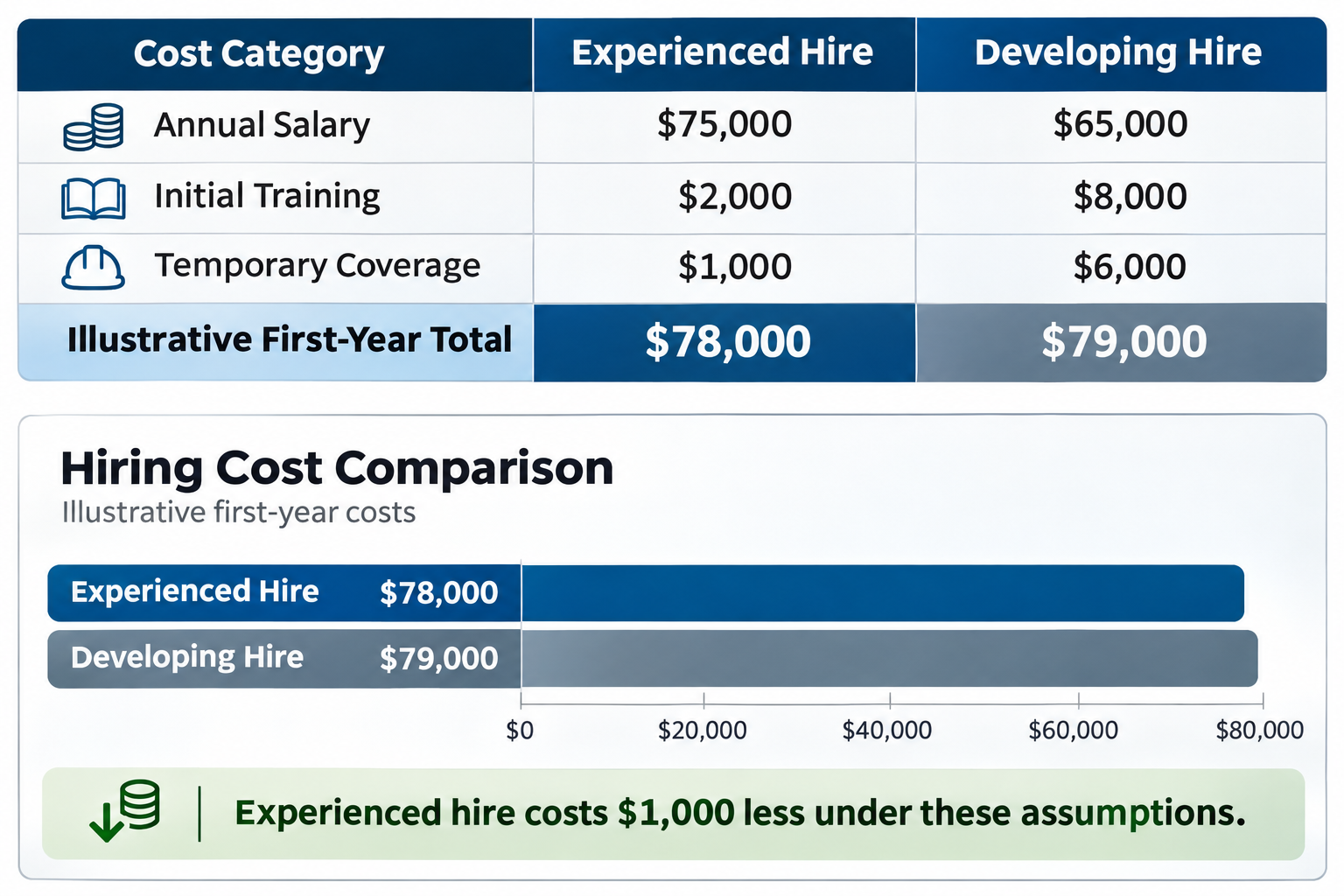
These figures are hypothetical and exclude benefits and other employment costs. The point is that salary alone can conceal important differences in total staffing costs.
Test Capability Instead of Making Assumptions
Employers should evaluate whether their screening processes measure actual job requirements.
An arbitrary preference for candidates who graduated recently, for example, tells an employer little about whether someone can troubleshoot equipment, manage inventory or supervise a production shift.
Similarly, familiarity with a particular software package should be assessed directly rather than inferred from a candidate's age.
Structured interviews, work samples and consistent evaluation criteria provide better evidence.
Employers should also remember that the federal Age Discrimination in Employment Act generally protects applicants and employees aged 40 and older from employment discrimination based on age at covered employers.
Fair recruitment is both a legal consideration and a business opportunity.
What Experienced Workers Can Do
Experienced job seekers have a role in making their capabilities visible.
Instead of presenting experience only as years of service, demonstrate what that experience produces.
Describe equipment failures resolved, production delays prevented, inventory improvements implemented or employees trained.
Show recent examples of learning unfamiliar technology.
Explain why the position fits your current career objectives without assuming the recruiter understands your motivations.
The goal is to make the connection between accumulated experience and the employer's immediate business problem unmistakable.
Hire for the Work That Needs Doing
Not every experienced candidate is automatically the strongest candidate.
Younger applicants can bring exceptional technical ability, fresh perspectives and valuable experience of their own.
The solution is not to exchange one age-based preference for another.
It is to evaluate applicants according to their ability to perform the work.
For a business experiencing difficult vacancies, unnecessarily excluding qualified applicants is a cost it may not be able to afford.
Why this matters
Employers seeking scarce skills should examine whether their own recruitment practices are narrowing the talent pool.
Hiring signal: Experience is a business capability, not merely a demographic characteristic.
CTA: Review the screening criteria for your three hardest-to-fill jobs. Identify any requirements that may unnecessarily exclude experienced applicants without improving hiring quality.
How StrikeForce can help: StrikeForce can help organizations identify transferable skills, evaluate candidates against operational requirements and broaden access to experienced talent.