
A manager consistently meets departmental targets.
Senior leadership praises the results. Deadlines are met. Production remains strong.
But employees working under the manager describe a different experience: public humiliation, unpredictable anger, threats and criticism that feels personal rather than constructive.
Several experienced employees leave.
The manager remains in place because, according to the company's performance metrics, the department is still succeeding.
This is how workplace bullying can become an organizational problem disguised as strong leadership.
Workplace Bullying Is Not a Minor Problem
The Workplace Bullying Institute's 2024 U.S. Workplace Bullying Survey reported that 32.3 percent of Americans in its survey had directly experienced workplace bullying.
That figure comes from a commissioned survey, not an official federal prevalence estimate. Definitions and research methods vary across workplace studies.
Nevertheless, the findings point to a significant issue that employers should not dismiss as ordinary interpersonal friction.
Peer-reviewed research published in the journal PLOS ONE has also identified associations between workplace bullying and adverse mental health outcomes.
For employees, repeated intimidation can make work psychologically exhausting.
For employers, harmful workplace behavior can contribute to absenteeism, disengagement, recruitment difficulties and avoidable departures.
A Tough Boss Is Not Necessarily a Bully
Employees sometimes receive criticism they would rather not hear.
Managers need to enforce safety standards, address poor performance, correct mistakes and hold employees accountable.
Those responsibilities are legitimate.
The difference is often visible in how authority is exercised.
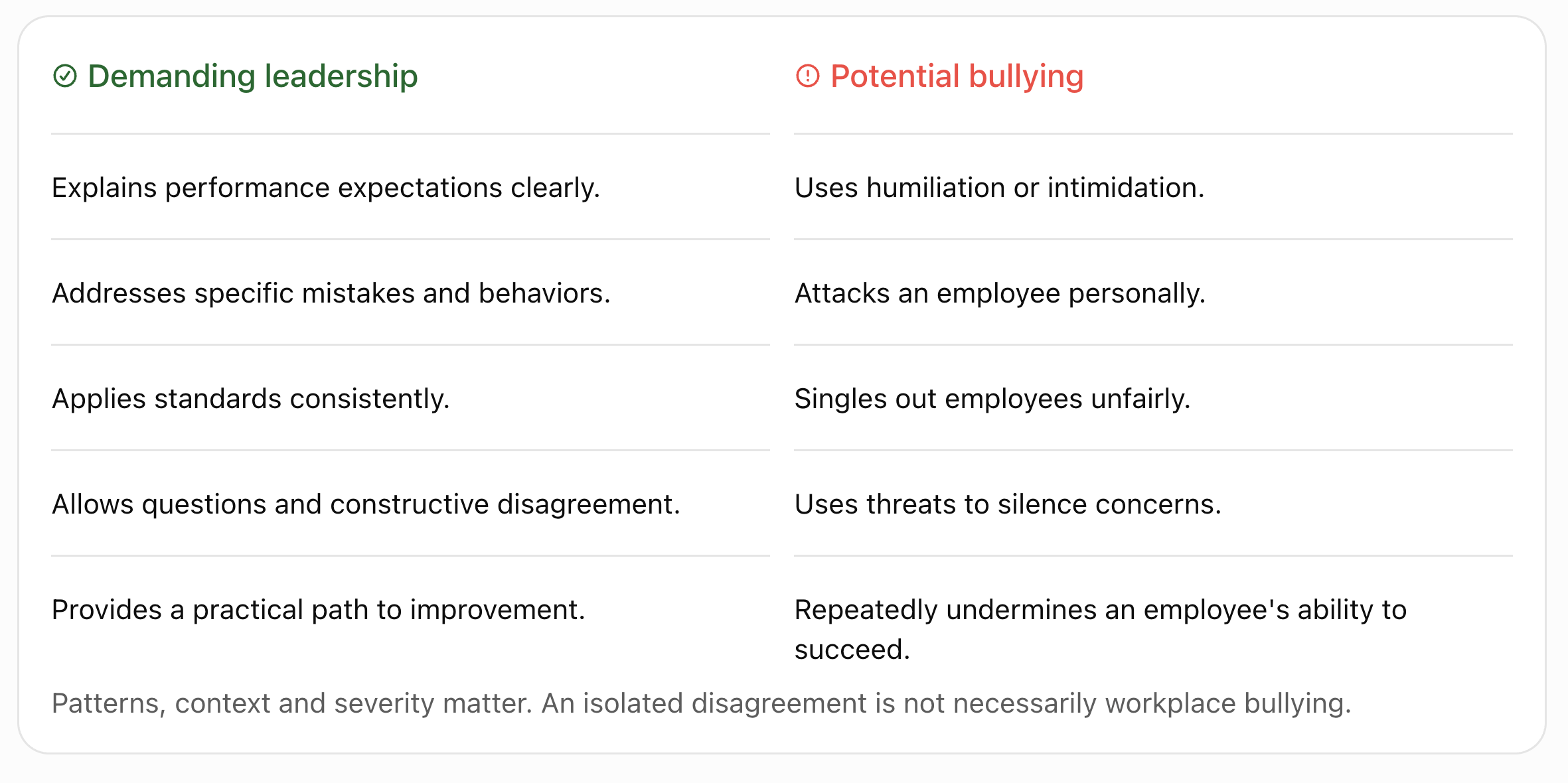
A demanding manager challenges employees to improve.
A bullying manager repeatedly uses authority in ways that demean, intimidate or undermine people.
The former can improve performance. The latter may create compliance driven by fear while damaging the workforce over time.
The Hidden Cost of Protecting a Harmful Manager
When a valuable employee resigns, the company may calculate recruitment expenses and the cost of filling the vacancy.
But the broader financial exposure can be more substantial.
Imagine three experienced employees leave a department over six months. The company's estimated replacement and disruption costs are $20,000 per employee.
That exposure may not appear on the manager's individual performance review.
Instead, it is distributed across recruitment budgets, overtime costs, training expenses and reduced operational capacity.
An organization that measures managers only by immediate output may therefore overlook behavior that is damaging long-term performance.
What Employees Can Do
Employees experiencing repeated intimidation or humiliation should document incidents factually.
Record dates, specific statements or actions, witnesses, relevant instructions and the impact on work.
Preserve records lawfully and consistently with applicable confidentiality obligations.
Review the organization's reporting procedures and consider available channels outside the direct management relationship, particularly when the immediate supervisor is the source of concern.
Depending on the circumstances, employees may also seek assistance from a union representative, employment attorney or relevant government agency.
Workplace bullying is not automatically unlawful under federal employment discrimination law.
The Equal Employment Opportunity Commission explains that unlawful harassment generally involves conduct based on protected characteristics and must meet applicable legal standards. Retaliation protections may also apply when employees engage in legally protected activity.
Understanding that distinction can help workers identify appropriate reporting options.
What Employers Need to Hear
A manager's ability to deliver results should not excuse harmful conduct.
Organizations should investigate credible complaints impartially, examine patterns across departures and employee feedback, and establish clear behavioral expectations.
Leadership evaluations should account for both what managers achieve and how they achieve it.
An effective leader can demand high standards without treating employees as disposable.
Why this matters
When organizations protect harmful managers because their departments appear productive, they may sacrifice the experienced workers responsible for that productivity.
Accountability should apply to leaders as consistently as it applies to employees.
Leadership signal: A manager's strong production numbers can conceal expensive damage to the workforce.
CTA for employers: Review exit-interview themes, absenteeism and complaints alongside departmental performance metrics. Investigate recurring patterns rather than waiting for another resignation.
CTA for employees: Document specific conduct, distinguish legitimate performance feedback from intimidation, and identify an appropriate reporting channel.
How StrikeForce can help: StrikeForce can assist employers with supervisor recruitment, leadership capability assessments and workforce planning that emphasizes sustainable performance.