
An IT specialist begins the morning resolving a complicated system problem.
Within an hour, a manager requests immediate assistance with a presentation. Another department sends an urgent software request. A meeting invitation appears for later that morning.
By lunchtime, the specialist has responded to several demands but has not completed the original task.
The following day, the manager asks why the system problem remains unresolved.
This is a familiar problem in many workplaces.
Employees are expected to deliver meaningful results while simultaneously responding to constant changes in what management considers important.
The organization may interpret unfinished work as an employee performance problem, even when its own management practices are contributing to the delay.
Interruptions Come With a Cost
Microsoft's June 2025 research report, Breaking Down the Infinite Workday, examined patterns of digital workplace activity, including meetings, emails and notifications.
Its analysis reported that employees in its studied Microsoft 365 population experienced frequent interruptions during core working hours.
The findings describe digital activity within that research population, not a universal measure of distraction across every workplace.
Nevertheless, they highlight a challenge familiar to office administrators, financial professionals, healthcare coordinators and technology teams: responding to work is not necessarily the same as completing work.
Peer-reviewed research by Gloria Mark and colleagues has also examined the consequences of interruptions, finding that interrupted workers may compensate by working faster while experiencing greater stress and frustration.
That distinction should interest employers.
Employees can appear responsive and productive while absorbing the hidden costs of constantly changing priorities.
Calculate the Management Cost
Consider a healthcare administration team with eight employees.
Each employee spends an estimated 30 minutes per working day dealing with avoidable interruptions and recovering their focus.
Assuming a blended labor cost of $35 per hour and 250 working days:
This is not an argument against communication or responding to urgent situations.
Healthcare teams must respond to patient needs. IT departments must address system failures. Financial services organizations must meet regulatory deadlines.
The question is whether all activities labeled urgent actually deserve to displace planned work.
Employees Need Permission to Prioritize
When managers continually introduce new assignments without reprioritizing existing responsibilities, employees face conflicting expectations.
They may feel pressure to promise completion of everything, even when the available time makes that impossible.
A better approach is to make trade-offs explicit.
When assigning a new urgent task, managers should identify which existing responsibility can be delayed, delegated or discontinued.
Employees can also respond constructively by asking:
I can prioritize this today. Which of my existing assignments should move to tomorrow so I can give it the attention it needs?
That question is not necessarily resistance to work. It provides the manager with the information needed to make an informed decision about limited capacity.
What Employers Wish Employees Understood
The problem is not exclusively management's responsibility.
Employees should communicate emerging delays, raise competing priorities early and avoid treating every request from a colleague as equally important.
An office administrator who independently accepts assignments from several departments may unintentionally create scheduling conflicts.
A financial analyst who notices that an urgent request will delay a major reporting deadline should communicate the conflict before the deadline passes.
Managers need visibility into workloads to allocate resources effectively.
Employees need clarity about priorities to deliver the expected results.
Both sides benefit when competing demands are discussed openly.
Establish a Shared Definition of Urgent
Organizations can improve workflow by distinguishing among three types of work:
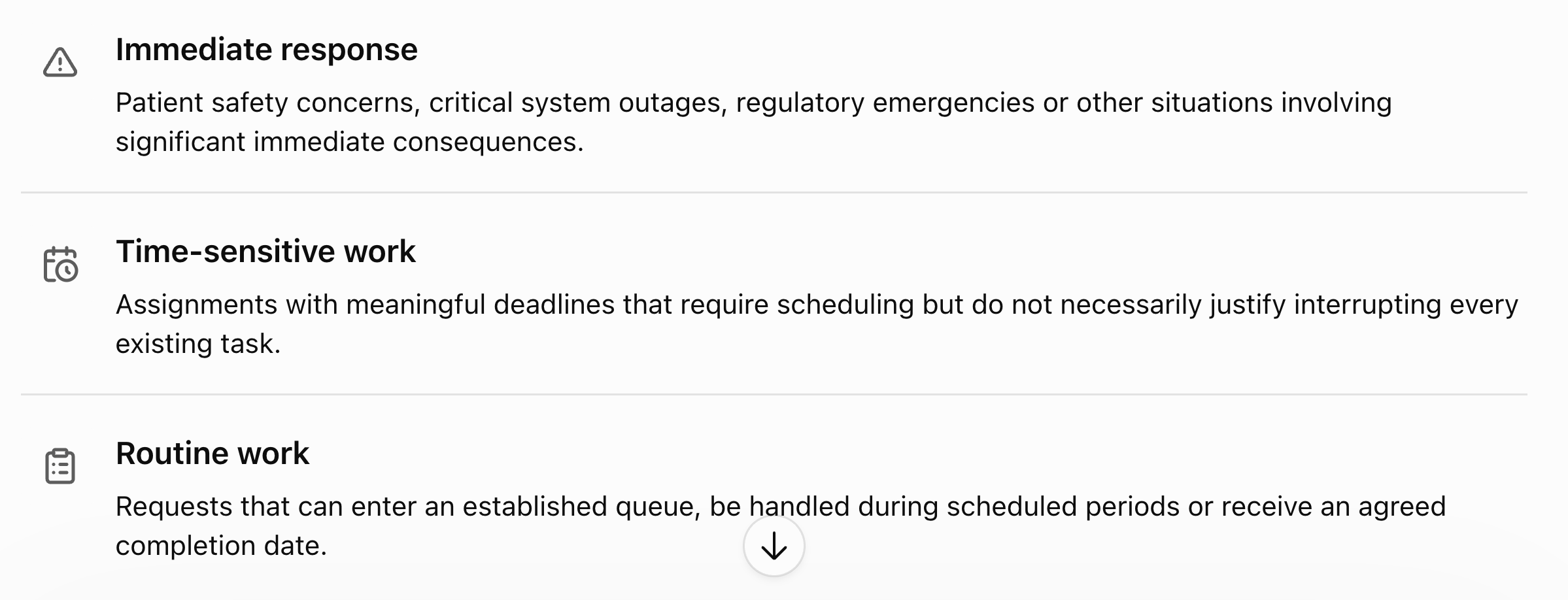
Making these distinctions helps prevent ordinary requests from becoming unnecessary operational emergencies.
Why This Matters
Experienced employees often possess the judgment and institutional knowledge that organizations depend on when difficult problems arise.
Constantly interrupting those employees can undermine the very capabilities employers value most.
The solution is not another corporate wellness campaign. It is better decisions about priorities, workload and accountability.
Retention signal: An employee who cannot finish important work may have a prioritization problem rather than a motivation problem.
CTA: For one week, track unscheduled urgent requests within your department. Identify which were genuine emergencies, which resulted from preventable planning problems and which could have been handled through normal scheduling.
How StrikeForce can help: StrikeForce can support employers in identifying staffing gaps, clarifying role responsibilities and recruiting professionals whose capabilities match actual operational requirements.